In recent years, the field of brain disease treatment has witnessed technological innovation, with transcranial electromagnetic combined stimulation emerging as a non-invasive neuromodulation technique that has garnered significant attention. This technology, which integrates transcranial electrical stimulation (TES) and transcranial magnetic stimulation (TMS), has gradually become an important means for the treatment and rehabilitation of brain diseases due to its potential synergistic effects. This article will delve into the mechanism, clinical application, and future development direction of transcranial electromagnetic combined stimulation, revealing the potential of this cutting-edge technology for you.
The Dilemma and Innovation in the Treatment of Brain Diseases
The number of patients suffering from global brain diseases (such as stroke, Parkinson's disease, Alzheimer's disease, depression, etc.) continues to rise, and existing pharmacological treatments exhibit significant limitations in efficacy and applicability. Pharmacological therapy often comes with side effects and yields suboptimal results for some patients, making the development of more effective and safer intervention methods urgently necessary. Meanwhile, the emergence of non-invasive neuromodulation technology has brought new hope to the treatment of brain diseases. Transcranial Electrical Stimulation (TES) and Transcranial Magnetic Stimulation (TMS), as two representative technologies, have gradually become hotspots in neuroscience research and clinical practice due to their non-invasiveness, safety, and ease of operation. The combined application of TES and TMS, forming transcranial electromagnetic combined stimulation, has demonstrated tremendous clinical value due to its significant synergistic effect.
The core mechanism of transcranial electromagnetic combined stimulation
The respective characteristics of transcranial electrical stimulation (TES) and transcranial magnetic stimulation (TMS)
Transcranial Electrical Stimulation (TES)
TES directly modulates neural activity in the cerebral cortex by applying weak electrical currents to the scalp. Its main forms include:
Transcranial Direct Current Stimulation (tDCS): It enhances or inhibits the excitability of neurons through anodal or cathodal current, respectively.
Transcranial alternating current stimulation (tACS): It induces neural oscillation synchronization with alternating current of specific frequencies, and has potential for intervention in diseases related to abnormal brain electrical rhythms.
Transcranial magnetic stimulation (TMS)
TMS utilizes magnetic fields to induce electric fields, thereby modulating cortical excitability. Its primary modes include:
- Repetitive Transcranial Magnetic Stimulation (rTMS): It modulates cortical excitability through different frequencies (low-frequency inhibition, high-frequency enhancement).
- theta burst stimulation (TBS): rapidly regulating cortical excitability through specific pulse patterns.
Synergistic mechanism of combined stimulation
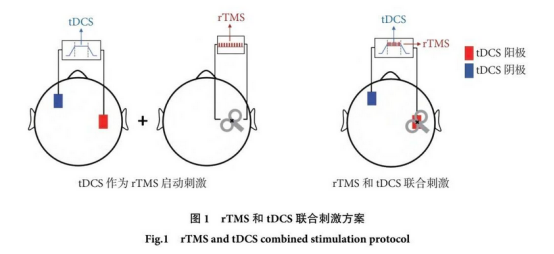
When TES and TMS are jointly applied, they act on the brain through different physical mechanisms, potentially producing the following synergistic effects:
TES provides the foundation for the stimulating effect of TMS by regulating neuronal membrane potential, thereby enhancing the neuronal firing rate and the duration of regulation.
TMS can activate synchronous firing of large-scale neurons, complementing the regional modulation of TES to achieve more precise neural regulation.

Clinical application of transcranial electromagnetic combined stimulation
Transcranial electromagnetic combined stimulation has demonstrated significant effects in the treatment of various brain diseases. The following are the clinical research progresses of several typical brain diseases:
Stroke rehabilitation therapy
Motor dysfunction: Combined stimulation improves motor function in stroke patients by regulating functional connectivity between hemispheres of the brain. Studies have shown that rTMS combined with tDCS can significantly shorten central motor conduction time and increase the amplitude of motor evoked potentials.
Cognitive dysfunction: Combined stimulation targeting the dorsolateral prefrontal cortex (DLPFC) can significantly improve memory function, shorten information processing speed, and enhance the overall efficiency of the cognitive network.
Improvement of motor function in Parkinson's disease (PD): Combined stimulation with gamma-band tACS and iTBS can significantly enhance LTP-like plasticity in the primary motor cortex, thereby improving the motor function of PD patients. Studies have shown that combined stimulation can significantly reduce intracortical inhibition, and the effect is more pronounced in patients with shorter disease duration.
Cognitive function intervention for Alzheimer's disease (AD): iTBS combined with γ-band tACS can enhance the γ oscillatory activity of the DLPFC and improve the cognitive function of AD patients. Furthermore, combined stimulation has also been proven to enhance the synchronicity of neural networks in the precuneus region.
Regulation of mood and cognitive function in major depressive disorder (MDD): iTBS combined with tACS can significantly improve the emotional state of MDD patients and enhance the activity of the prefrontal cortex network. Compared to single stimulation methods, combined stimulation has more advantages in improving depressive symptoms and cognitive function.
Conclusion>>
As an emerging neuromodulation technology, transcranial electromagnetic combined stimulation is gradually changing the landscape of brain disease treatment. It not only demonstrates significant effects in improving patients' motor, cognitive, and emotional functions, but also provides important directions for the development of future neuromodulation technologies. With continuous research, Dukang Medical looks forward to this technology benefiting more patients and bringing new hope to the rehabilitation of brain diseases.
Source of this article:
Wei Yujia, Wang Tingyu, Wang Chunfang, Zhang Ying. Review. Xu Guizhi. Advances in the clinical application of transcranial electromagnetic combined stimulation in brain diseases. Journal of Biomedical Engineering, August 2025, Volume 42, Issue 4
Disclaimer: The content of this article is for reference only. For specific treatment plans, please follow the advice of a professional doctor.
Copyright notice: This article is for sharing purposes only. The copyright of the article belongs to the original author. Reproduction without permission is prohibited.